
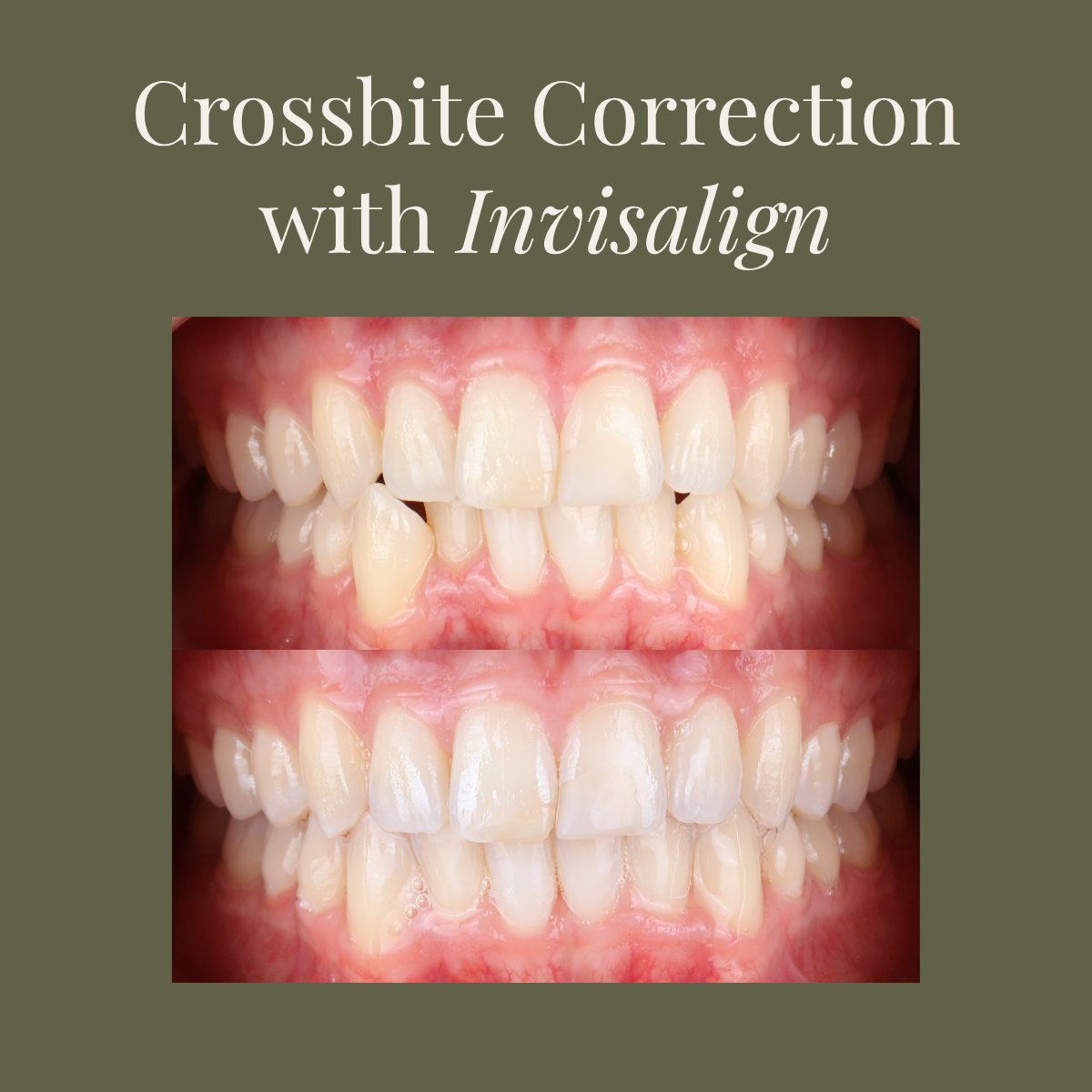
Can Invisalign Fix a Crossbite? A Real Smile Transformation in Chattanooga, TN
Dr. Zack Youngblood
By Dr. Zack Youngblood | MDRN MUSE Dental Aesthetics
When most people think about Invisalign, they imagine straightening crooked teeth or closing small gaps in their smile. But what if the problem goes deeper than appearances? What if your teeth don't fit together correctly when you bite down?
That's exactly where treating a crossbite becomes important.
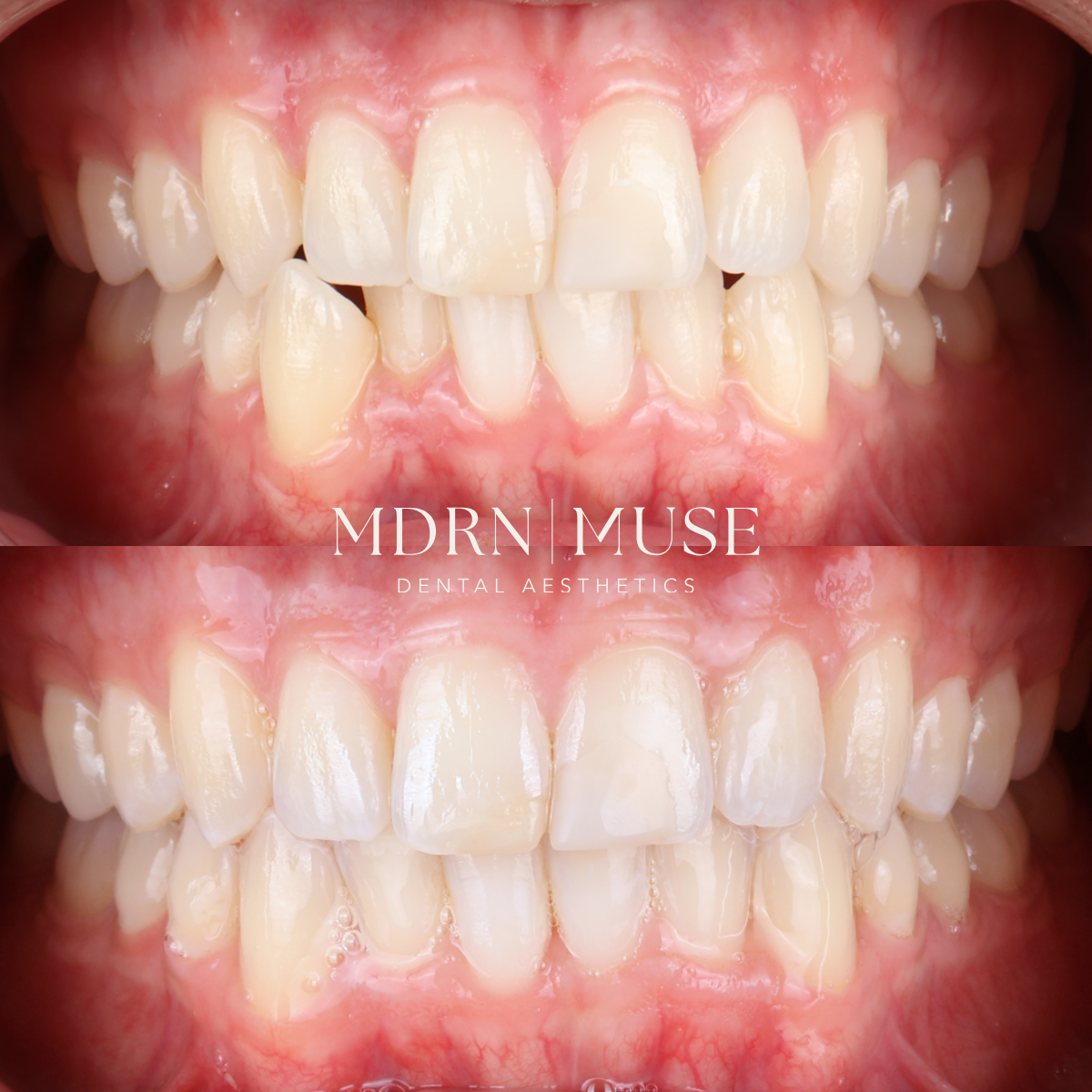
One of the most rewarding parts of practicing cosmetic dentistry is helping patients discover that a beautiful smile and a functional bite can go hand in hand. I recently completed an Invisalign case at MDRN MUSE Dental Aesthetics in Chattanooga, Tennessee, where we successfully corrected both a crossbite and dental crowding.
This transformation is a great example of why I believe Invisalign should be about more than simply straightening teeth.
So, can Invisalign fix a crossbite? Yes. Invisalign can successfully correct many dental crossbites by gradually repositioning the teeth with custom clear aligners. However, the type and severity of the crossbite, particularly whether it involves the teeth or the underlying jaw structure, determine whether Invisalign is the best treatment option.
Let's explore what a crossbite is, why correcting one matters, and how modern Invisalign treatment can help create a healthier, more balanced smile.
What Is a Crossbite?
A crossbite is a type of malocclusion, or improper bite, that occurs when one or more upper teeth sit inside the lower teeth rather than fitting slightly outside them when you bite together.
In a properly aligned bite, the upper teeth generally overlap the lower teeth in a specific relationship that allows your teeth to function together.
When that relationship is reversed in certain areas, it's called a crossbite.
There are two main types:
Anterior Crossbite
An anterior crossbite occurs when one or more upper front teeth sit behind the lower front teeth when biting together.
This can affect the appearance of your smile and may contribute to abnormal contact or wear on the affected teeth.
Posterior Crossbite
A posterior crossbite involves the back teeth. One or more upper back teeth bite inside their corresponding lower teeth rather than outside them.
Depending on the severity and location, a posterior crossbite can also contribute to an uneven bite or a functional shift of the lower jaw.
Some crossbites involve only tooth positioning, while others involve differences in jaw width or skeletal development. Identifying that difference is essential before choosing treatment.
Can Invisalign Fix a Crossbite in Adults?
Yes. Many adults with dental crossbites can be treated successfully using Invisalign clear aligners.
Unlike traditional braces, Invisalign uses a series of removable, custom-made aligners designed to move teeth gradually toward their planned positions.
When correcting a dental crossbite, these movements may help reposition teeth that have been biting incorrectly and improve the relationship between the upper and lower arches.
Depending on the case, treatment may involve:
- Moving individual teeth into better alignment.
- Correcting rotations that contribute to improper tooth contact.
- Coordinating the upper and lower dental arches.
- Creating additional space to address crowding.
- Using attachments or orthodontic elastics when necessary to guide specific movements.
However, I always explain to my patients that not every crossbite can be corrected with Invisalign alone.
For example, an adult with a significant skeletal discrepancy between the upper and lower jaws may require a different treatment approach or evaluation by an orthodontic specialist.
That's why a comprehensive bite evaluation is just as important as examining how straight your teeth appear.
Book Your New Patient Experience - By Phone
Book Your New Patient Experience - Online
Check your in-network status with MDRN MUSE Dental Aesthetics
A Real Invisalign Transformation at MDRN MUSE: Correcting Crossbite and Crowding
I recently finished an Invisalign case that illustrates exactly why I love providing clear aligner treatment.
This patient had two problems that needed to be addressed: a crossbite and dental crowding.
Crowding occurs when there isn't enough space for the teeth to align properly, causing teeth to overlap, rotate, or sit outside their ideal positions.
When crowding and a crossbite occur together, the challenge isn't simply making the front teeth look straighter. We also need to consider how the upper and lower teeth fit together as a complete system.
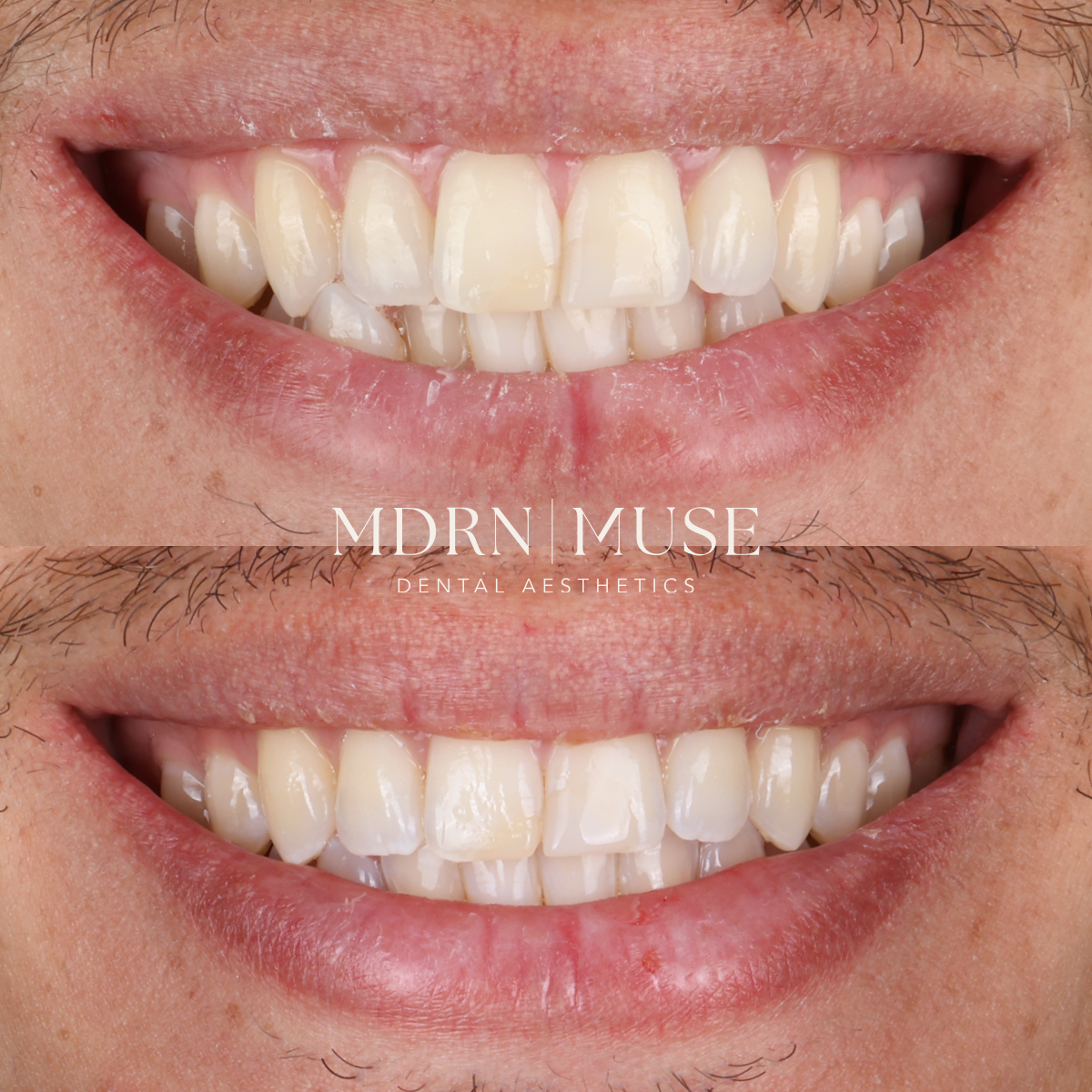
For this patient, our treatment successfully corrected the crossbite while resolving the crowding.
The result was a straighter, more balanced smile with improved tooth alignment and bite relationships.
What I appreciate most about cases like this is that we're working with the patient's natural teeth. Instead of covering crooked teeth with cosmetic restorations, orthodontic treatment allows us to address the underlying positioning.
It's an approach that reflects one of my personal philosophies in dentistry: whenever possible, preserve healthy natural tooth structure while creating a smile that functions as beautifully as it looks.
Why Is It Important to Correct a Crossbite?
A crossbite isn't always painful, and some people live with one for years without realizing their bite is misaligned.
But just because a crossbite doesn't hurt doesn't mean it's something we should automatically ignore.
Depending on the severity, an untreated crossbite may contribute to several concerns.
1. Uneven Tooth Wear
When teeth contact each other in an abnormal relationship, certain surfaces may experience excessive or poorly distributed forces.
Over time, this can contribute to unusual enamel wear or damage in some patients.
Correcting the underlying tooth positions may help improve those contacts.
2. An Uneven Bite
Some crossbites cause the jaw to shift to one side when the teeth come together.
This can create a bite that feels unbalanced or that functions differently from the intended jaw position.
Not every crossbite causes a functional shift, which is why an individual examination matters.
3. Difficulty Cleaning Crowded Teeth
When a crossbite is accompanied by crowding, overlapping teeth may create areas that are more difficult to brush and floss thoroughly.
These areas can retain plaque and make maintaining healthy gums more challenging.
Straightening crowded teeth can improve access for daily cleaning, although good oral hygiene and routine preventive care remain essential.
4. Smile Asymmetry
Crossbites and rotated teeth can sometimes affect the visible balance of a smile.
Correcting those positions can improve dental symmetry and help create a more harmonious appearance.
For many patients, that's the first benefit they notice, even though improving function is just as important to me.
How Does Invisalign Correct Crowded Teeth and Crossbites at the Same Time?
This is where careful treatment planning becomes essential.
Crowding and crossbites are often connected because the position and available space of individual teeth can influence how the upper and lower arches fit together.
Before beginning Invisalign, I evaluate the overall bite rather than focusing only on the teeth that appear crooked.
At MDRN MUSE Dental Aesthetics, we use our iTero Lumina digital scanner to capture a detailed 3D model of your teeth.
This allows us to evaluate tooth positions, discuss your goals, and develop a customized orthodontic treatment plan. Our technology can also provide a quick simulation of potential smile changes, although that preview isn't a guaranteed treatment outcome.
As treatment progresses, different teeth can be moved in a planned sequence to address both alignment and bite relationships.
In appropriate cases, this may involve creating space through controlled tooth movement, carefully planned arch development, or interproximal reduction when clinically indicated.
By treating the full bite instead of isolating one crooked tooth, we can work toward results that look natural and function properly.
If you're curious about what the overall Invisalign experience looks like, I've also written a guide on Invisalign treatment in Chattanooga.
Book Your New Patient Experience - By Phone
Book Your New Patient Experience - Online
Check your in-network status with MDRN MUSE Dental Aesthetics
Is Invisalign Better Than Braces for Crossbite Correction?
One question I frequently hear is whether Invisalign works as well as traditional braces for correcting bite problems.
The answer depends on the specific case.
For many mild to moderate dental crossbites, Invisalign can be an effective alternative to conventional braces.
Clear aligners also offer advantages that many adults appreciate, including their discreet appearance and the ability to remove them for eating, brushing, and flossing.
However, traditional braces or specialized orthodontic treatment may provide more predictable control in certain complex cases.
Severe skeletal discrepancies, significant jaw-width differences, and some challenging tooth movements may require treatment beyond clear aligners alone.
I believe the best treatment isn't necessarily the newest or most popular option. It's the one that gives the individual patient the most predictable, healthy long-term outcome.
How Long Does Invisalign Take to Fix a Crossbite?
There isn't one universal treatment timeline for crossbite correction.
A mild crossbite involving only a few teeth may require less treatment than a more complicated case involving crowding, multiple teeth, or significant bite discrepancies.
Many comprehensive Invisalign treatments take approximately 12 to 18 months, but some are shorter and others require considerably longer.
Additional aligners or refinement stages may also be necessary to achieve the desired result.
The best way to determine how long your treatment might take is through a clinical examination and individualized digital treatment plan.
And remember, consistent aligner wear is essential. Most patients need to wear their Invisalign aligners for approximately 20 to 22 hours each day, following their provider's instructions.
How Much Does Invisalign Cost for Crossbite Correction in Chattanooga?
At MDRN MUSE Dental Aesthetics, our standard comprehensive Invisalign treatment fee is $5,500. (The actual out-of-pocket cost can vary based on your individual circumstances, available orthodontic insurance benefits, and financing approval.)
Because crossbite correction often involves both improving dental alignment and coordinating the bite, comprehensive treatment planning may be important.
Our comprehensive Invisalign treatment includes custom aligners, digital treatment planning, and ongoing monitoring, with retainers included to help maintain your results after treatment.
We also offer financing options for qualified patients.
The actual out-of-pocket cost can vary based on your individual circumstances, available orthodontic insurance benefits, and financing approval.
For a more detailed explanation of pricing, read my article on the cost of Invisalign in Chattanooga.
Why I Approach Invisalign Differently as a Cosmetic Dentist
When I look at a smile, I see more than individual teeth.
I evaluate how the teeth fit together, how their position affects the overall smile, and how we can improve their appearance while preserving natural structure.
That's especially important when treating crossbites and crowding.
It's possible for teeth to look relatively straight from the front while still having an unhealthy or unbalanced bite.
My goal is to address both.
At MDRN MUSE, we combine digital technology with an individualized, patient-first approach to treatment.
I want every patient to understand why we're recommending a particular treatment, what we're trying to accomplish, and what realistic results they can expect.
Sometimes that means using Invisalign alone. Other times, Invisalign may be part of a larger cosmetic treatment plan.
I've also explained how Invisalign can help prepare your teeth for veneers, particularly when improving tooth positions first allows us to be more conservative.
But one of the things I love most about Invisalign is that many patients can achieve the smile they want without needing restorative cosmetic work at all.
Is Fixing Your Crossbite With Invisalign Worth It?
If you've been living with a crossbite or crowded teeth, you may be wondering whether orthodontic treatment is really necessary.
The answer depends on your bite, your oral health, and your personal goals.
Not every minor crossbite requires treatment, and not every patient needs to pursue orthodontics for aesthetic reasons.
But when misalignment contributes to abnormal tooth contacts, cleaning difficulties, or concerns about your smile, treatment may offer meaningful benefits.
In my experience, patients often start Invisalign because they want their teeth to look straighter.
By the end, they appreciate that we've addressed something more fundamental: how their teeth work together.
If you're still considering the investment, I encourage you to read my article, Is Invisalign Worth It? A Cosmetic Dentist's Perspective.
Book Your New Patient Experience - By Phone
Book Your New Patient Experience - Online
Check your in-network status with MDRN MUSE Dental Aesthetics
Frequently Asked Questions About Invisalign and Crossbites
Can Invisalign completely fix a crossbite?
Invisalign can fully correct many dental crossbites, but outcomes depend on the severity of the condition and whether the problem involves tooth positioning, jaw structure, or both. Some patients require braces, additional appliances, or specialist treatment.
Can Invisalign fix a crossbite and crowded teeth at the same time?
Yes. Invisalign can treat both crowding and dental crossbites within a comprehensive orthodontic treatment plan. The tooth movements must be carefully coordinated to achieve appropriate alignment and bite relationships.
Can adults fix a crossbite without braces?
Many adults can correct dental crossbites using clear aligners rather than traditional braces. Significant skeletal crossbites, however, may require other treatment approaches.
What happens if a crossbite is left untreated?
Some crossbites remain relatively stable, while others may contribute to uneven tooth wear, abnormal tooth contacts, or functional jaw shifts. The potential risks depend on the individual bite and should be evaluated clinically.
Does Invisalign hurt when correcting a crossbite?
Patients may feel temporary pressure or mild soreness as teeth begin moving, particularly when switching to new aligners. Significant or persistent pain should be discussed with your dentist.
How do I know if I have a crossbite?
When you bite together, look for upper teeth that sit inside their corresponding lower teeth rather than outside them. A dentist can determine whether the relationship represents a crossbite and whether treatment is recommended.
Will I need retainers after Invisalign crossbite correction?
Yes. Retention is an important part of orthodontic treatment. Teeth can shift after Invisalign, so retainers help maintain the corrected alignment and bite relationship. Your dentist will recommend an appropriate long-term retention schedule.
Ready to Find Out If Invisalign Can Fix Your Crossbite?
If you have crowded teeth, an uneven bite, or a crossbite that you've always wanted to correct, I would love to help you understand your options.
At MDRN MUSE Dental Aesthetics in Chattanooga, Tennessee, we believe that dentistry should be about more than achieving a beautiful smile. It's about protecting your oral health, preserving your natural teeth, and building confidence through truly personalized care.
Whether Invisalign is the right solution or another approach makes more sense, we'll help you make an informed decision.
Book Your New Patient Experience - By Phone
Book Your New Patient Experience - Online
Check your in-network status with MDRN MUSE Dental Aesthetics
