
How Many Porcelain Veneers Do You Need? A Cosmetic Dentist in Chattanooga Explains
Dr. Zack Youngblood
One of the first questions patients ask during a veneer consultation is, “How many porcelain veneers do I actually need?”
The answer is different for every patient.
Some people may only need two veneers to improve a small gap or repair worn teeth. Others may need six, eight, or ten veneers to create a balanced smile. In some cases, veneers may not even be placed on the front teeth.
At MDRN MUSE Dental Aesthetics in Chattanooga, TN, we do not begin a smile makeover by choosing a predetermined number of veneers. We begin by studying your natural smile, evaluating your existing dental work, and determining which teeth need to be treated to create the most natural result.
There Is No Standard Number of Veneers
Porcelain veneers are thin, custom-made restorations that are bonded to the front surfaces of teeth. They can improve the color, shape, size, spacing, symmetry, and overall appearance of a smile.
However, veneers are not a one-size-fits-all treatment.
You may see cosmetic dentistry cases online involving six, eight, or ten veneers, but that does not mean you need the same number. The right number depends on your smile, your goals, your existing dental work, and how many teeth are visible when you speak and smile.
The goal should not be to place as many veneers as possible. The goal should be to treat the correct teeth and create a smile that looks balanced, natural, and appropriate for your face.
The Most Important Question: How Many Teeth Show When You Smile?
One of the biggest factors we consider is how many upper teeth naturally show when you smile.
Some people have a narrow smile that primarily displays the front six teeth. Other patients have a wider smile that reveals eight, ten, or even twelve teeth.
If you have a wide smile and only place veneers on the front four or six teeth, the untreated teeth farther back may still be visible. Differences in color, shape, or alignment can become noticeable, especially if the veneers are significantly lighter than the natural teeth.
For this reason, the number of veneers should usually be based on your visible smile rather than an arbitrary number.
During a cosmetic consultation, we evaluate:
- How many teeth show when you smile
- The width and shape of your smile
- Your lip position
- Your gumline
- Tooth color
- Tooth proportions
- Existing crowns, bridges, veneers, or fillings
- Your bite and tooth position
- Your cosmetic goals
At MDRN MUSE Dental Aesthetics, we do not start by counting teeth. We start by studying your smile.
Book Your New Patient Experience - By Phone
Book Your New Patient Experience - Online
Check your in-network status with MDRN MUSE Dental Aesthetics
Can You Get Only Two Veneers?
Yes. Some patients only need two porcelain veneers.
Two veneers may be appropriate when the concern is limited to the front two teeth. This may include:
- A small space between the front teeth
- Chipped or fractured teeth
- Uneven tooth shapes
- Old bonding that needs to be replaced
- Discoloration affecting only one or two teeth
- Small or undersized lateral incisors
The challenge with treating only one or two teeth is achieving a precise color match with the surrounding natural teeth. Porcelain can be customized carefully, but matching a single veneer to natural enamel may be more technically demanding than treating several teeth together.
In the right situation, two veneers can create a meaningful improvement without changing the entire smile.
When Are Four Veneers Enough?
Four veneers typically involve the four upper front teeth.
This may be an option for someone with a relatively narrow smile or concerns that are limited to the central and lateral incisors.
Four veneers may help improve:
- Minor spacing
- Small or uneven front teeth
- Mild discoloration
- Worn or chipped edges
- Uneven tooth proportions
However, patients with wider smiles may still show their canine teeth and premolars. If those teeth differ significantly in color or shape, treating only four teeth may not create the most seamless result.
Why Do Many Patients Get Six Veneers?
Six veneers usually include the front six upper teeth, from canine to canine.
This is a common treatment range because these teeth often make up the central portion of the smile. Six veneers may improve:
- Tooth color
- Tooth shape
- Small gaps
- Mild crowding
- Chipped or worn teeth
- Uneven tooth lengths
- Smile symmetry
However, six veneers do not always have to be placed on the front six teeth.
The correct six teeth depend on the patient’s existing smile and restorations.
Book Your New Patient Experience - By Phone
Book Your New Patient Experience - Online
Check your in-network status with MDRN MUSE Dental Aesthetics
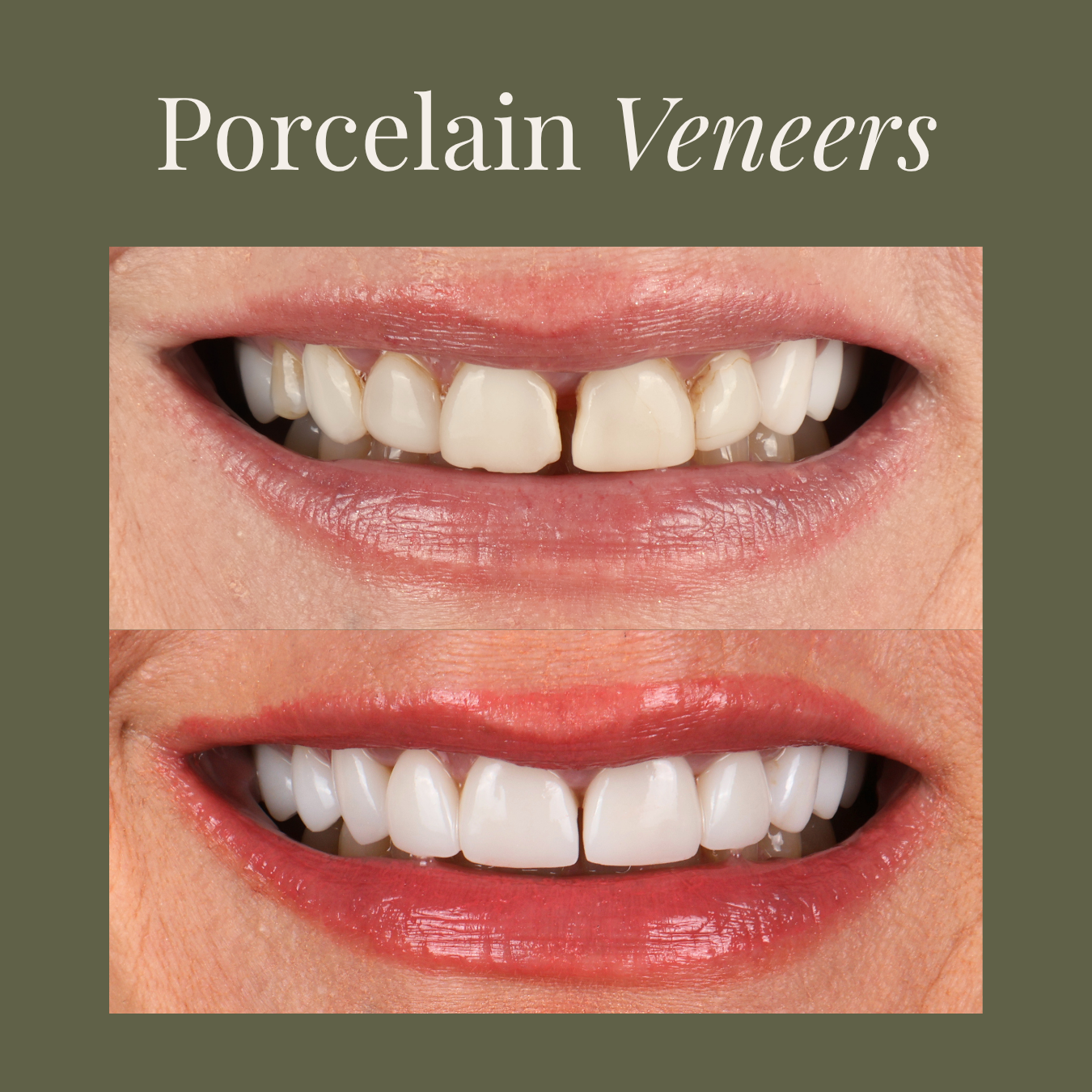
A Real Patient Example: Six Veneers That Were Not Placed on the Front Six Teeth
A recent porcelain veneer case at MDRN MUSE Dental Aesthetics is a perfect example of why every smile makeover must be planned individually.
This patient already had an existing porcelain bridge near the front of her smile. The bridge was healthy, functional, and something she genuinely liked.
Instead of automatically removing and replacing healthy porcelain, we designed the new smile around it.
We placed six porcelain veneers on other visible teeth and carefully matched the new veneers to the existing bridge. This allowed us to create a more balanced, cohesive smile without unnecessarily replacing dental work that was already functioning well.
The case also demonstrates that veneers do not always need to follow a standard front-six pattern.
In cosmetic dentistry, the best treatment plan is not always the most obvious one. Sometimes the right approach is to preserve what already looks good and improve the teeth surrounding it.
Can Veneers Be Matched to an Existing Bridge or Crown?
Yes, porcelain veneers can often be matched to existing crowns, veneers, or bridges.
The process requires careful evaluation of the existing porcelain’s:
- Color
- Translucency
- Surface texture
- Shape
- Brightness
- Reflective qualities
Natural teeth and porcelain restorations reflect light differently. Matching new veneers to older porcelain requires detailed photography, accurate shade communication, and close collaboration between the cosmetic dentist and dental laboratory.
In some cases, replacing older restorations may produce a more predictable result. In other cases, healthy and attractive dental work can remain in place.
The decision should be based on the condition of the existing restoration, the patient’s goals, and whether the new porcelain can be matched successfully.
When Do Patients Need Eight Veneers?
Eight veneers usually extend farther back in the smile and may include the upper premolars.
This is often recommended for patients who show more teeth when smiling.
Eight veneers may create a smoother transition between the front and back teeth, particularly when the patient wants a noticeably brighter smile.
Treating eight teeth may also help improve:
- A wider smile
- More extensive discoloration
- Multiple uneven or worn teeth
- Broader changes in tooth shape
- Darker teeth visible near the corners of the smile
- Differences between existing restorations and natural teeth
An eight-veneer case can provide a broader and more uniform result without necessarily treating every visible tooth.
When Are Ten or More Veneers Recommended?
Patients with very wide smiles may show ten or more upper teeth.
If a patient wants to make a significant change in tooth color, treating only the front six teeth may leave darker natural teeth visible farther back. In these cases, ten veneers may provide a more consistent appearance across the entire smile.
Ten or more veneers may also be considered when there is:
- Extensive wear
- Generalized discoloration
- Multiple old restorations
- Significant differences in tooth shape
- A broad smile that displays premolars
- A full smile makeover involving several visible teeth
More veneers do not automatically mean a better result. The number should always be based on what is necessary to accomplish the patient’s goals.
Book Your New Patient Experience - By Phone
Book Your New Patient Experience - Online
Check your in-network status with MDRN MUSE Dental Aesthetics
Does a Wider Smile Mean You Need More Veneers?
Often, yes.
Patients with wider smiles generally show more teeth. If your natural teeth are similar in color and shape to the planned veneers, you may still be able to treat fewer teeth.
However, if you want much lighter porcelain or your side teeth have different shapes, discoloration, fillings, or wear, additional veneers may help create a more natural transition.
This is why smile photography is so important during the planning process. Teeth that may not seem noticeable when looking in a bathroom mirror can become very visible in a full smile photograph.
Do All Veneers Need to Be the Same Shade?
Veneers placed within the same smile should appear cohesive, but that does not mean every tooth needs to be completely identical.
Natural teeth have subtle variations in color, translucency, texture, and brightness. Well-designed porcelain should reflect those natural differences.
Creating veneers that are too flat, too opaque, or too uniform may make the smile appear artificial.
The goal is not to create identical white rectangles. The goal is to create teeth that work together naturally while still reflecting light in a lifelike way.
When veneers are being matched to an existing crown or bridge, the shade and character of that restoration may influence the design of the new porcelain.
Can You Place Veneers Only on Side Teeth?
Yes.
Porcelain veneers can be placed on side teeth when those teeth are visible in the smile and need improvement.
Side teeth may be treated to:
- Broaden the smile
- Improve color consistency
- Correct narrow or undersized teeth
- Replace old bonding
- Improve symmetry
- Match existing front crowns, veneers, or bridges
Our recent six-veneer case is an example of this approach. The patient’s existing front porcelain was healthy and attractive, so we focused on the surrounding teeth that needed improvement.
Should Healthy Crowns or Bridges Be Replaced During a Smile Makeover?
Not always.
Healthy restorations should not automatically be removed simply because a patient is considering veneers.
Before recommending replacement, we evaluate whether the existing crown or bridge is:
- Structurally sound
- Free from decay
- Functioning properly
- Esthetically acceptable to the patient
- Compatible with the planned smile design
If the existing porcelain looks good and can be matched, preserving it may reduce the amount of dental treatment needed.
However, if the restoration is damaged, poorly fitting, significantly darker than the desired smile, or incompatible with the new design, replacement may be recommended.
A conservative treatment plan should preserve healthy tooth structure and existing dentistry whenever it makes clinical and esthetic sense.
More Veneers Do Not Automatically Mean a Better Smile
The number of veneers should not be viewed as a measure of quality.
A patient who receives four veneers may achieve a more natural result than someone who receives ten if four are all that is needed.
Placing unnecessary veneers may increase treatment cost and require preparation of teeth that did not need to be treated.
On the other hand, placing too few veneers may create visible differences between the porcelain and untreated teeth.
The best treatment plan finds the balance between achieving the patient’s goals and preserving as much healthy tooth structure as possible.
Book Your New Patient Experience - By Phone
Book Your New Patient Experience - Online
Check your in-network status with MDRN MUSE Dental Aesthetics
What If My Teeth Need Whitening Before Veneers?
Teeth whitening may be recommended before veneer treatment, especially if some natural teeth will remain visible.
Porcelain does not whiten after it is made. The final veneer shade is selected based on the surrounding teeth and the patient’s desired result.
If you plan to whiten your natural teeth, it is usually best to complete whitening before the final veneer shade is selected. This allows the dental laboratory to match the veneers to your brighter natural teeth.
Whitening may also reduce the number of veneers needed if the untreated teeth can be improved enough to blend naturally with the porcelain.
What If My Teeth Are Crooked?
Porcelain veneers can sometimes improve the appearance of mildly crooked, rotated, or uneven teeth.
However, veneers are not always the best first treatment for significant crowding or bite problems.
In some cases, Invisalign treatment before veneers can move the teeth into better positions, reduce the amount of tooth preparation required, and create a more conservative result.
The number of veneers needed may change after orthodontic treatment because the teeth are better aligned and more evenly displayed.
How Does Digital Smile Design Help Determine the Number of Veneers?
Smile design allows the cosmetic dentist to plan the shape, size, proportions, and position of the proposed veneers before treatment begins.
Photography, digital scans, facial analysis, and mockups can help determine:
- Which teeth are visible
- Which teeth need to change
- How far back the veneers should extend
- Whether existing restorations should remain
- How the new smile will fit the patient’s face
- Whether the proposed number of veneers creates symmetry
This helps ensure that the treatment plan is based on the complete smile rather than individual teeth viewed in isolation.
Dr. Zack’s Tip
One of the biggest misconceptions about porcelain veneers is that every patient needs the same number.
Some patients may only need two veneers, while others may benefit from eight or ten. In certain cases, the veneers may not even be placed on the front teeth.
The most important factor is how many teeth show in your natural smile and which teeth need to be treated to create a balanced result.
My goal is not to recommend more veneers than necessary. It is to design a smile that looks natural, protects healthy tooth structure, and reflects the individual patient.
How Do You Know How Many Veneers You Need?
The only reliable way to determine how many veneers you need is through a cosmetic dentistry consultation.
During your consultation, your dentist should evaluate your smile from several angles, not just look at individual teeth.
At MDRN MUSE Dental Aesthetics, veneer planning may include:
- A detailed cosmetic consultation
- Professional smile photography
- Digital scans
- Evaluation of your bite
- Review of existing crowns, veneers, or bridges
- Discussion of your preferred tooth color and shape
- Digital smile design or a smile mockup when appropriate
After reviewing these factors, we can recommend the number of veneers that will provide the most natural and conservative result.
Book Your New Patient Experience - By Phone
Book Your New Patient Experience - Online
Check your in-network status with MDRN MUSE Dental Aesthetics
Frequently Asked Questions About How Many Veneers You Need
How many veneers do most people get?
Many cosmetic veneer cases involve six, eight, or ten veneers, but there is no universal number. Some patients may only need two or four veneers, while others may need more than ten. The correct number depends on how many teeth show when the patient smiles and which teeth need cosmetic improvement.
Do veneers always go on the front six teeth?
No. Veneers do not always need to be placed on the front six teeth. They can be placed on any visible teeth that need improvement. In some cases, existing front crowns or bridges may remain in place while veneers are added to neighboring teeth.
Can I get veneers on only two teeth?
Yes. Two veneers may be appropriate for a small gap, chipped teeth, old bonding, uneven tooth shapes, or discoloration limited to two teeth. The surrounding natural teeth must be considered carefully so the veneers can be matched properly.
Is six veneers enough?
Six veneers may be enough for patients with a narrow smile or cosmetic concerns limited to the front portion of the smile. Patients with wider smiles may benefit from eight or ten veneers to prevent untreated teeth from showing at the corners of the smile.
How many veneers do I need for a wide smile?
Patients with wide smiles often need eight, ten, or more veneers because more teeth are visible. The final number depends on tooth color, smile width, existing restorations, and how noticeable the untreated teeth would be.
Can veneers be matched to an existing bridge?
Yes. New porcelain veneers can often be matched to an existing bridge if the bridge is healthy, attractive, and compatible with the planned smile design. Precise shade matching and communication with the dental laboratory are essential.
Should I replace an existing crown when getting veneers?
Not necessarily. A healthy crown may remain in place if it looks good and can be matched to the new veneers. Replacement may be recommended if the crown is damaged, poorly fitting, significantly discolored, or incompatible with the desired result.
Can veneers be placed on side teeth?
Yes. Veneers can be placed on canines, premolars, and other side teeth that show in the smile. Treating side teeth may broaden the smile, improve color consistency, and create a smoother transition from the front teeth.
Do more veneers look more natural?
Not automatically. Natural results depend on treatment planning, porcelain design, tooth proportions, surface texture, translucency, and how well the veneers blend with the surrounding smile. The ideal number is the smallest number that can predictably accomplish the patient’s goals.
How does a cosmetic dentist decide how many veneers to recommend?
A cosmetic dentist evaluates how many teeth show when the patient smiles, the width of the smile, tooth color, existing restorations, tooth position, bite, gumline, facial proportions, and the patient’s goals. Photography, digital scans, and smile design may also be used.
Book Your New Patient Experience - By Phone
Book Your New Patient Experience - Online
Check your in-network status with MDRN MUSE Dental Aesthetics
