
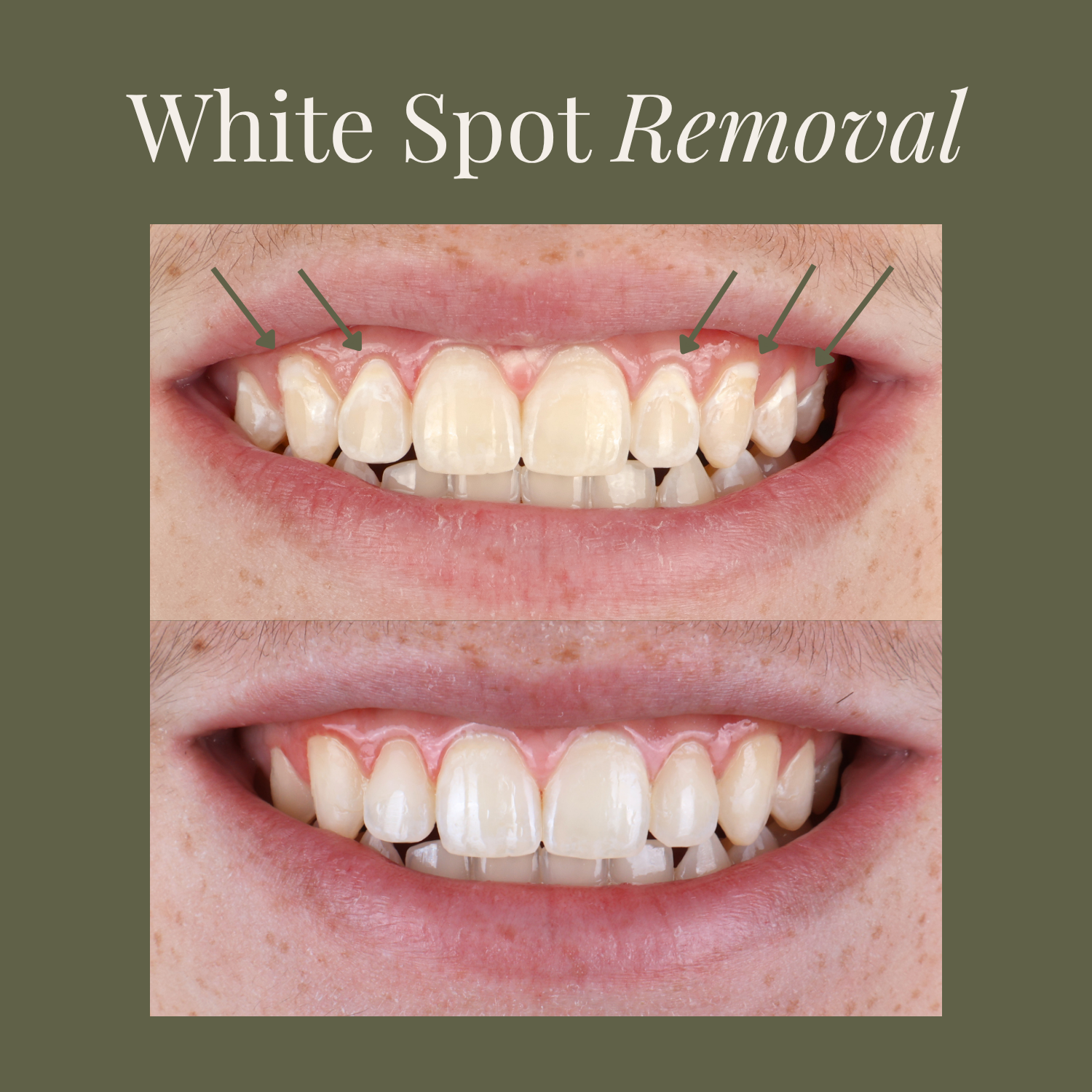
White Spot Removal in Chattanooga, TN: ICON Treatment vs. Composite Bonding
Dr. Zack Youngblood
Have you ever finished orthodontic treatment, looked in the mirror, and noticed bright white spots on your teeth that weren't there before? Or maybe you've had small white marks on your teeth for as long as you can remember and wondered if there's a way to get rid of them.
You're not alone.
White spot lesions are one of the most common cosmetic concerns we see at MDRN MUSE Dental Aesthetics. Although they're usually harmless, they can become much more noticeable after teeth are professionally whitened or when they appear on the front teeth.
The good news is that white spots can often be dramatically improved without removing healthy tooth structure. Modern cosmetic dentistry offers conservative treatment options that can blend these spots into the surrounding enamel and create a more even-looking smile.
In this guide, we'll explain exactly what white spot lesions are, why they happen, and how treatments like ICON resin infiltration and cosmetic bonding can help restore a more uniform smile.
What Are White Spot Lesions?
White spot lesions are areas of enamel that have a different mineral content than the surrounding tooth. Because of this change in the enamel, these areas reflect light differently, making them appear chalky, opaque, or brighter than the rest of the tooth.
Despite their appearance, a white spot isn't always a cavity. In many cases, the tooth is still healthy and strong. The discoloration is simply the result of changes that occurred while the enamel was forming or after the tooth erupted into the mouth.
White spot lesions can vary significantly in size, shape, and depth. Some are barely noticeable, while others cover a large portion of the front teeth and become the first thing someone notices when they smile.
Why Do White Spots Appear on Teeth?
There isn't just one reason why white spot lesions develop. Instead, several different factors can affect how enamel forms or loses minerals over time.
Some of the most common causes include:
- Orthodontic treatment with traditional braces
- Early enamel demineralization
- Naturally occurring enamel development differences
- Excess fluoride exposure while teeth are developing (fluorosis)
- Previous trauma to a developing tooth
- Certain developmental conditions that affect enamel formation
Although the causes are different, the result is often the same: areas of enamel that look brighter than the surrounding tooth.
Understanding why the white spot formed helps your dentist determine which treatment will produce the best cosmetic result.
Why Do White Spots Often Develop After Braces?
One of the most common reasons people notice white spots is after completing orthodontic treatment.
Braces create many small areas where plaque and food particles can collect. Even patients who brush well may find it difficult to completely clean around brackets and wires.
When plaque remains on the teeth for extended periods, bacteria produce acids that pull minerals from the enamel. This process is called demineralization.
Once the braces are removed, the previously covered enamel becomes visible. Instead of seeing perfectly uniform teeth, patients may notice bright white areas surrounding where the brackets once sat.
The encouraging news is that many of these lesions can be successfully treated with minimally invasive cosmetic procedures.
Book Your New Patient Experience - By Phone
Book Your New Patient Experience - Online
Check your in-network status with MDRN MUSE Dental Aesthetics
Can You Get White Spots Without Ever Having Braces?
Absolutely.
Many patients are surprised to learn that white spot lesions can develop even if they've never had orthodontic treatment.
Some people naturally have slight variations in how their enamel formed during childhood. Others may have experienced a minor injury to a tooth while it was developing beneath the gums. Fluorosis can also produce white markings that range from barely noticeable to more widespread.
Because every case is different, an examination is the best way to determine why your white spots developed and which treatment option is most appropriate.
Are White Spot Lesions Cavities?
Not necessarily.
This is one of the biggest misconceptions about white spots.
Some white spot lesions represent very early enamel demineralization that has not progressed into a cavity. Others are purely cosmetic and have no active decay at all.
During your examination, we'll evaluate the teeth to determine whether the enamel is healthy, whether the lesion is inactive, or whether additional treatment is necessary before considering cosmetic improvement.
The presence of a white spot doesn't automatically mean you need a filling.
Can White Spots Go Away on Their Own?
Unfortunately, once a white spot has formed, it usually doesn't disappear completely on its own.
In some cases, the enamel may naturally remineralize slightly, making the lesion less noticeable over time. However, most white spots remain visible because the internal structure of the enamel has already changed.
For patients who are bothered by the appearance of these lesions, cosmetic treatment is often the most predictable way to improve the smile.
Are White Spots a Sign of Poor Brushing?
Not always.
Although poor plaque control during orthodontic treatment can certainly contribute to white spot formation, many patients with excellent oral hygiene still develop them.
Some white spots are completely unrelated to brushing habits.
That's why it's important not to assume someone "didn't take care of their teeth" simply because they have white spot lesions.
Every patient's enamel develops differently, and many causes are outside of anyone's control.
Book Your New Patient Experience - By Phone
Book Your New Patient Experience - Online
Check your in-network status with MDRN MUSE Dental Aesthetics
How Does a Dentist Determine What's Causing a White Spot?
Before recommending treatment, we carefully evaluate several factors, including:
- The location of the lesion
- Its size and depth
- Whether it's active or inactive
- How it responds when the tooth is dried
- The patient's dental history
- Previous orthodontic treatment
- Overall enamel health
This evaluation helps determine whether ICON treatment, cosmetic bonding, or another option will provide the most natural-looking result.
Can Whitening Toothpaste Remove White Spots?
Unfortunately, no.
Whitening toothpaste removes surface stains from the outside of teeth. White spot lesions are located within the enamel itself.
Because of this, whitening toothpaste cannot blend or eliminate the underlying discoloration.
Some abrasive whitening products may even make the surrounding enamel appear brighter, causing the white spot to become more noticeable.
Will Professional Teeth Whitening Make White Spots Better or Worse?
This is a question we hear often.
Immediately after whitening, white spot lesions frequently appear more noticeable because the surrounding enamel becomes lighter first.
This temporary increase in contrast is normal.
As the teeth rehydrate over the following days, the appearance often softens slightly. However, whitening alone will not eliminate the lesion.
In fact, many patients choose ICON treatment after whitening because the white spots become easier to see once the rest of the smile has brightened.
Book Your New Patient Experience - By Phone
Book Your New Patient Experience - Online
Check your in-network status with MDRN MUSE Dental Aesthetics
What Is ICON Treatment?
ICON is one of the most exciting advances in minimally invasive cosmetic dentistry.
Rather than covering the white spot with a filling or removing healthy tooth structure, ICON works by infiltrating the porous enamel with a clear resin.
This resin changes how light travels through the enamel, allowing the treated area to blend much more naturally with the surrounding tooth.
The goal isn't to cover the white spot.
The goal is to make it far less noticeable by restoring a more uniform appearance to the enamel.
Because almost no healthy tooth structure is removed, ICON is considered one of the most conservative cosmetic procedures available.
How Does ICON Remove White Spots?
The treatment works by changing the optical properties of the enamel.
After carefully preparing the surface of the tooth, a specialized resin is applied to the porous enamel.
The resin fills microscopic spaces within the lesion that previously scattered light differently from healthy enamel.
Once the resin is cured and polished, the treated area often blends dramatically better with the surrounding tooth.
The result is a smile that appears more even without drilling away healthy enamel.
Is ICON Treatment Painful?
In most cases, patients experience very little discomfort.
Because ICON generally does not require drilling or injections, treatment is comfortable for the vast majority of patients.
Many people compare the appointment to having their teeth professionally polished.
How Long Does ICON Treatment Take?
Treatment time depends on the number of teeth involved and the severity of the lesions.
Many patients complete treatment in a single appointment lasting about one to two hours.
More extensive cases may require additional time, but most patients leave the office with immediate cosmetic improvement.
How Long Do ICON Results Last?
The resin used during ICON treatment is designed to become part of the treated enamel.
With good oral hygiene and regular dental care, results can remain beautiful for many years.
Like any cosmetic dental procedure, maintaining healthy teeth and avoiding habits that stain or damage enamel will help preserve your results.
Book Your New Patient Experience - By Phone
Book Your New Patient Experience - Online
Check your in-network status with MDRN MUSE Dental Aesthetics
When Is Composite Bonding a Better Option?
Although ICON is an outstanding treatment, it isn't the right solution for every white spot.
Some lesions are too deep, too extensive, or involve structural changes that cannot be completely blended using resin infiltration alone.
In these situations, cosmetic bonding may provide a more predictable result.
Composite bonding uses tooth-colored resin to reshape or mask the affected area while matching the surrounding tooth as naturally as possible.
The goal is still the same: creating a smile that looks balanced and natural.
What's the Difference Between ICON and Composite Bonding?
Both treatments improve white spot lesions, but they work in very different ways.
ICON treats the enamel from within by infiltrating the lesion and blending its appearance without adding material to the tooth.
Composite bonding covers the affected area with carefully layered tooth-colored composite that is sculpted and polished to match your natural enamel.
Whenever possible, we prefer the most conservative treatment that can achieve an excellent cosmetic result.
For many patients, that means ICON. For others, composite bonding offers the best long-term outcome.
Can Severe White Spots Still Be Treated?
Yes.
Even larger or more noticeable lesions often have treatment options.
Some patients benefit from ICON alone.
Others achieve the best results with cosmetic bonding.
Occasionally, a combination of treatments provides the most natural appearance.
Your treatment recommendation depends on the depth of the lesion, its location, and your cosmetic goals. In select cases, porcelain veneers may also be considered when discoloration extends beyond what ICON or bonding can predictably improve.
Will Bonding Match My Natural Teeth?
Modern composite materials are remarkably lifelike.
By carefully selecting shades and layering different opacities, composite bonding can closely mimic the natural translucency and color variations found in healthy enamel.
When performed carefully, bonding blends beautifully with the surrounding tooth.
Book Your New Patient Experience - By Phone
Book Your New Patient Experience - Online
Check your in-network status with MDRN MUSE Dental Aesthetics
Which Treatment Is Right for Me?
There isn't a one-size-fits-all answer.
Choosing the right treatment depends on several factors, including:
- Why the white spot developed
- How deep the lesion extends into the enamel
- The size of the affected area
- Your cosmetic goals
- The overall condition of the tooth
During your consultation, we'll evaluate each tooth individually and explain which treatment is likely to produce the most natural-looking result.
Can White Spots Come Back?
Once a successfully treated lesion has been addressed, it typically does not return in the same location.
However, new white spot lesions can develop if enamel becomes demineralized again due to plaque buildup or other factors.
Maintaining excellent oral hygiene and attending regular dental visits remain the best ways to protect your smile.
How Can You Prevent White Spot Lesions?
Although not every white spot can be prevented, healthy habits greatly reduce the risk.
These include:
- Brushing twice daily with fluoride toothpaste
- Cleaning carefully around orthodontic appliances
- Flossing every day
- Keeping regular professional cleanings
- Following your dentist's recommendations during orthodontic treatment
- Maintaining a balanced diet that's low in frequent sugary snacks and drinks
Healthy enamel is much less likely to develop new areas of demineralization.
Should White Spots Be Treated Even If They Don't Hurt?
White spot lesions are often completely painless.
For many patients, treatment is purely cosmetic.
If the appearance of your smile makes you feel self-conscious, treatment may help you feel more confident when talking, laughing, and smiling.
At MDRN MUSE Dental Aesthetics, our goal isn't to create a different smile. It's to help you feel like the best version of your own smile.
How Much Does White Spot Removal Cost?
The cost of treatment depends on several factors, including:
- The number of teeth involved
- The size of the lesions
- Whether ICON or composite bonding is recommended
- The complexity of the case
After evaluating your smile, we'll provide a personalized treatment plan and discuss all available options before beginning treatment.
Looking for White Spot Removal in Chattanooga, TN?
If you've been hiding your smile because of white spots on your teeth, know that you have options.
Whether your white spot lesions developed after braces, occurred naturally, or resulted from changes in enamel development, modern cosmetic dentistry can often produce remarkable improvements with conservative treatment.
At MDRN MUSE Dental Aesthetics, we believe cosmetic dentistry should preserve healthy tooth structure whenever possible while creating results that look beautifully natural.
If you're wondering whether ICON treatment or cosmetic bonding is the right solution for your smile, we'd love to help you explore your options.
A consultation allows us to evaluate your teeth, explain exactly what's causing the white spots, and recommend the treatment that will give you the most predictable and natural-looking outcome.
Book Your New Patient Experience - By Phone
Book Your New Patient Experience - Online
Check your in-network status with MDRN MUSE Dental Aesthetics
